
Microbusinesses are one of the most important forces in Vietnam’s economy, yet they are also among the most vulnerable to cash flow fluctuations and the growing demands of financial management, tax compliance, and digital transformation. Most of their business decisions do not revolve around long-term growth but rather focus on sustaining day-to-day operations: ensuring sufficient cash to replenish inventory, collecting receivables on time, paying suppliers, and preparing for upcoming tax obligations.
Against this backdrop, Finan, in collaboration with ideaLAB, conducted customer behavior research under the Innovation Fund component,[i] part of the CARE-led Strive Women initiative, to better understand how microbusinesses manage their finances, adopt technology, and adapt to policy changes. The study employed a mixed-methods approach combining qualitative and quantitative research and examined six key areas: cash flow management, financial record-keeping, tax compliance, access to credit, ability to use digital tools, and gender-related factors in financial management.
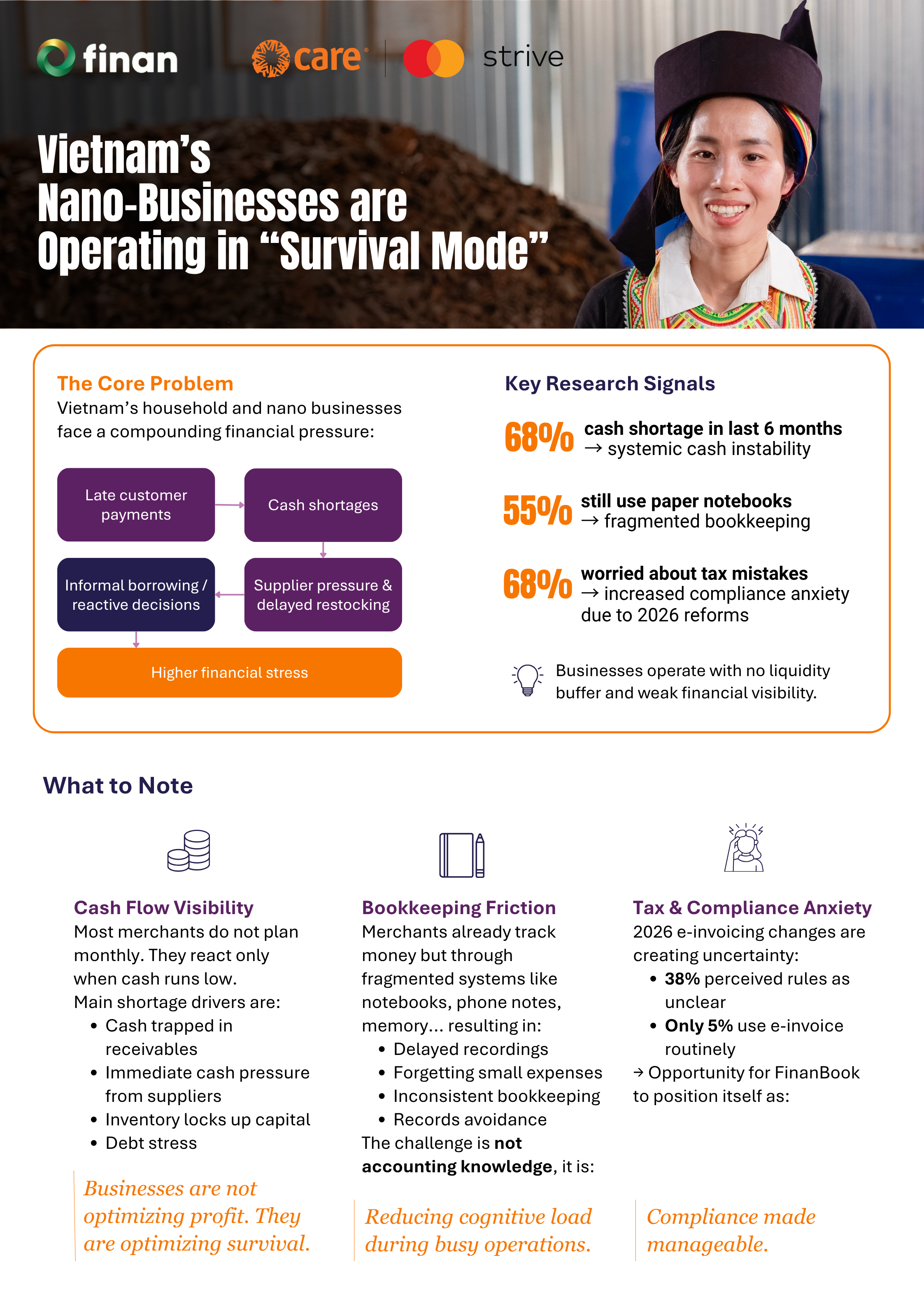
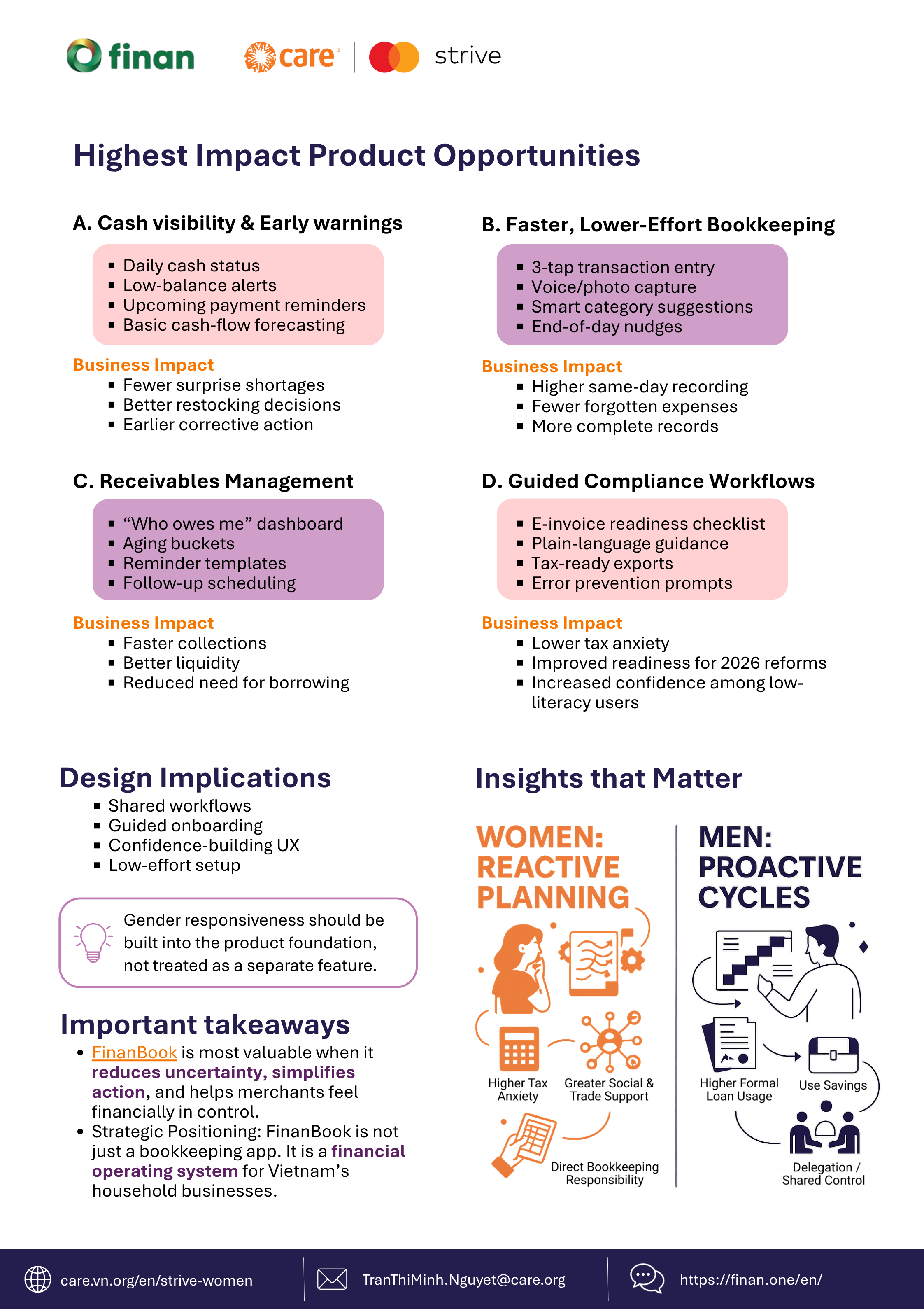
The findings show that most microbusinesses operate with very limited financial buffers. Cash flow shortages are common, largely due to timing mismatches between cash inflows and outflows, while financial planning remains predominantly reactive. Many business owners do keep financial records, but the information is fragmented across paper notebooks, mobile phones, memory, and multiple other tools, making it difficult to accurately track cash flow, receivables, payables, and profitability. Managing receivables and payables, accessing formal credit, and preparing for tax and e-invoicing requirements also remain challenging due to insufficient data, limited guidance, and time constraints.
The study also finds that differences between male and female business owners do not reflect differences in financial management capabilities. Rather, they largely stem from differences in household roles, decision-making authority, access to resources, and the amount of time available to manage business operations. This underscores the need to design user-centered financial solutions that integrate gender considerations from the outset of product development, rather than adding them at a later stage.
Building on these findings, the study identifies the quality and timeliness of financial data as a critical leverage point for addressing multiple challenges faced by microbusinesses. A simple record-keeping system, when maintained consistently, can help users gain greater visibility into cash flow, manage receivables and payables more effectively, make better-informed business decisions, prepare more effectively for tax obligations, and gradually build a financial track record that can facilitate access to formal sources of finance.
More broadly, the study confirms that microbusinesses want to manage their finances more effectively; what they need are tools that fit the realities of their day-to-day operations, reduce cognitive burden, and deliver immediate, practical value. These insights provide a foundation for developing user-centered digital financial solutions that can strengthen the financial health of microbusinesses and support more inclusive digital transformation across the microenterprise sector.
For the full report in English, please download it here.
[i] The Innovation Fund (2025–2026) is a component of the Strive Women initiative, implemented by Finan under CARE’s leadership, with support from the Mastercard Center for Inclusive Growth. The Innovation Fund’s key activities include: (i) conducting research to assess the financial behaviors of microbusinesses in Vietnam; and, based on the research findings, (ii) developing an E-learning Hub and a set of highly practical financial tools designed to help close capability gaps among microbusinesses.