
On March 23, 2026, CARE in Vietnam, in collaboration with the Community Development Center (CDC), has officially launched the project MekongElevate “Ethnic Communities Leading Inclusive Climate Action”.
Implemented from now until March 2029 in Muong Chanh and Muoi Noi communes, Son La province, the project will provide upland communities – specifically ethnic minority women, youth, and people with disability – with solutions to enhance climate resilience, thereby contributing to the overall stability and prosperity of the Mekong subregion.
MekongElevate is funded by the Australian Government through the Mekong-Australia Partnership (MAP) and is implemented by CARE and local partners.
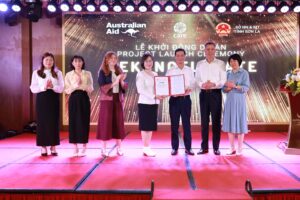
Alice Clare Hawkins, Second Secretary (Development), DFAT, echoed the goal of MAP and MekongElevate project “Our Mekong-Australia Partnership supports local responses to shared regional challenges. Australia is proud to partner with Vietnam to support a more inclusive and resilient Mekong subregion. The MekongElevate project addresses our shared priorities of climate resilience, gender equality, and inclusion. It will invest in people – particularly women, people with disability, and marginalised groups – providing them with skills and opportunities to lead and shape their own paths in the green transition”.
Sharing at the event, Mr Nguyen Thanh Cong, Deputy Chairman of Son La Provincial People’s Committee, highlighted the key value of coffee in the provincial economy as well as a pathway to support local farmers to address both the market and farming challenges. “With an area exceeding 32,000 hectares, Son La is currently a key Arabica coffee-growing region of Vietnam. However, the industry is facing significant challenges from extreme climate change and increasingly stringent international requirements for sustainability standards and traceability. Consequently, the province is decisively promoting replanting with adaptive varieties, applying advanced deep-processing technologies, and transitioning to green, low-emission production models to enhance competitive value and ensure long-term livelihoods for local farmers.”
Throughout the implementation period, the project will focus on supporting ethnic minorities, women, youth, and people with disability within the coffee industry. Key activities include increasing the adoption of climate-smart agriculture practices and other innovations to strengthen climate-resilient livelihoods.
Furthermore, the second pillar of the project will focus on boosting access to safety nets and recovery mechanisms. These efforts aim to help ethnic minority communities recover from unavoidable loss and damage caused by natural disasters or extreme weather events. The project also prioritises activities that promote the participation and leadership of youth, people with disability, and ethnic minority women in climate-related decision-making processes.
In the context of the Mekong Sub-region facing extreme climate change impacts that directly threaten food security and social stability, the MekongElevate project is implemented with the strategic goal of building adaptive and resilient communities. The project focuses on promoting Climate-Smart Agriculture (CSA) by transferring sustainable farming techniques and fostering innovation to protect people’s long-term livelihoods.
Alongside strengthening social security systems and disaster risk contingency mechanisms, MekongElevate places a special emphasis on equality and inclusion. The project is committed to fostering leadership and amplifying the voices of women, youth, and persons with disabilities within ethnic minority communities, ensuring they become key actors in climate-related governance and decision-making processes from the local to the regional level.
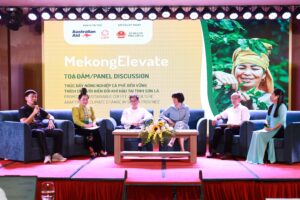
“At CARE, we believe that lasting solutions to the climate crisis depend on who can participate in them. Too often, women, youth, and people with disabilities face barriers that limit their access to economic opportunities and disaster preparedness. Through MekongElevate, we work alongside communities to help reduce these barriers, strengthen practical skills, and improve access to resources, so the green transition is more inclusive and no one is left behind,” shared Ms. Vuong Thai Nga, Program Director of CARE in Vietnam, during the event.
Please refer to the full press release here.